
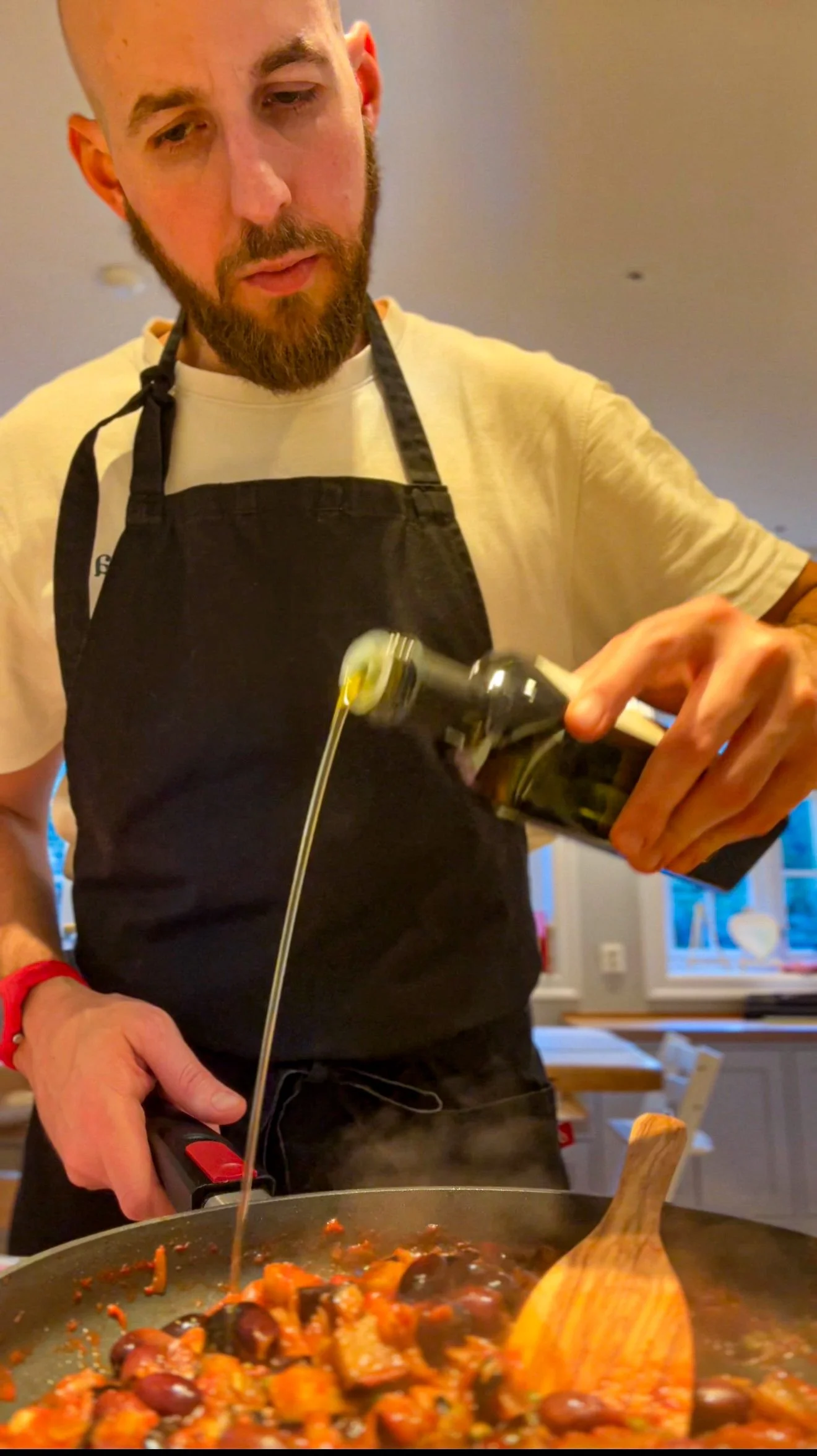
When we hear about successful people in America having a private chef, most of us imagine someone with a huge house, a lot of money and a chef cooking fancy meals for them every day.
But more often than not, that's far from the truth. There's something much more interesting behind this.
And it has very little to do with the food itself.
Ever thought about how much time you actually spend on food every day? We all think that food is the moment you sit down to eat. But that's actually just the desired result, and maybe the quickest part of the whole process.
Let me explain. Food begins much earlier than that. When the simple question pops into your head during the day while you're still at work.
"What are we going to eat tonight?"
And there it begins.
You start thinking about what you're in the mood for, what you have in the fridge, what you could make with it, what you need to buy and whether you even feel like cooking that particular thing tonight.
Then comes the stop at the supermarket on your way home. What should be a quick stop most often turns into pointless walking around, looking for something you need, buying a few things you probably didn't need and ending up forgetting the one thing you actually wanted to add to your dish.
And when you're finally home and dinner feels closer, you're not even halfway through.
You have to unpack everything, organise what you need, and then start chopping, preparing and cooking. If you're pretty fast and organised, that might take 30–45 minutes.
Meanwhile, you're also trying to clean and tidy up the mess while the food is cooking, because the last thing you want after dinner is a kitchen full of dirty bowls and pans.
And eventually, you sit down to eat.
The funny thing is that this is the part we actually wanted from the beginning. And probably the quickest part of the whole process.
That's the real work that goes into food every day. And that's the good scenario.
Because some days we're simply mentally and physically exhausted. We get home after a long day, have absolutely no energy left to cook and end up ordering takeaway or eating some ready-made, ultra-processed food that we wouldn't normally eat and regret the moment we're done eating.
And the funny thing is that it wasn't necessarily what you wanted, but it was the easiest option at that moment, when your head was spinning.
And tomorrow, the same routine comes back again.
The problem is that we get used to it and sadly rarely realise how much time all this takes. Because it doesn't happen all at once. It all adds up slowly but surely. A little thinking here, a quick stop there, some preparation, some cleaning.
It has become such a normal part of everyday life that we don't even question it anymore! That's our reality! And that's where the answer to the original question lies.
Why do so many successful people in America pay someone else to take care of their meals?
Because at some point, they figure out that their time is worth more to them and start valuing it properly.
And the thing is, having a chef do your weekly meal prep doesn't mean having a full-time chef in your kitchen every evening.
In reality, it means having someone come to your home once a week, prepare several proper meals from scratch with real ingredients and leave everything ready for the days ahead.
You simply come home from work, heat up your dinner, finish it the way you would if you were cooking it yourself and sit down to eat.
No wondering what to cook. No unnecessary supermarket stops. No spending your evening preparing everything from the beginning.
Just good food and the rest of your evening to do whatever you want. Some days, it even feels like cheating.
And you get those extra hours back to maybe spend with your family and kids. Go for that workout you're always trying to find time for. Finish something you've been putting off. Or simply relax and enjoy yourself.
And that's the part we often forget when we think about the cost of having someone cook for us. It costs money, but everything does. The question is, how much do you personally value your own time?
It doesn't necessarily mean that every hour you save needs to become another productive hour or make you more money. Everyone has different priorities and goals. But sometimes, simply having an hour to yourself after a long day is worth just as much.
And don't get me wrong. I'm a chef. I love cooking. I've spent most of my life doing it. But I also struggle with it some days. When the jobs are piling up, when problems need immediate attention, or when I'm trying to find time for my workout after a long workday. That's why I'm prepping my own meals the same way I do for our clients.
Now, here in Norway, some people still think of a private chef as someone you hire for a special occasion. A birthday, an anniversary or a dinner with friends.
But lately I've noticed that more and more people are looking at it a little differently. Maybe it's all the media and exposure we see on social media and from places like America that make us realise it's just a normal service — and more accessible than many people think — at the end of the day.
Not only as someone who cooks for us on special occasions, but also as someone who can make our weekdays easier in practical ways.
Because in the end, I don't think the reason successful Americans have private chefs is simply that they can afford one.
It's that they've started realising more and more that their time is better spent doing something else, something they value more.
And maybe that's another big question worth asking ourselves. What do we value most?